This energy is harvested from adenosine triphosphate ATP generated through the cells metabolism. Secondary active transport involves the use of an electrochemical gradient.
Active Transport Primary Secondary Overview Article Khan Academy
Active Transport is the term used to describe the processes of moving materials through the cell membrane that requires the use of energy.
. Some pumps which carry out primary active transport couple directly with ATP to drive their action. Describe what the proton motive force is and explain. Active transport uses energy stored in ATP to fuel this transport.
Describe an instance of facilitated diffusion of protons H during the light reactions and explain why this instance of facilitated diffusion does not require energy. Primary active transport also called direct active transport directly uses chemical energy such as from adenosine triphosphate or ATP in case of cell membrane to transport all species of solutes across a membrane against their concentration gradient. It is a selective process as certain molecules can only be transported by certain proteins.
It requires energy in the form of ATP. A primary active transportb secondary active transport c facilitated diffusion d passive diffusion e osmosis Answer. To move substances against a concentration or electrochemical gradient the cell must use energy.
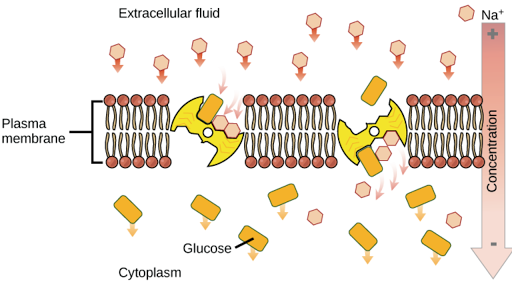
In secondary active transport the ATP is not used directly and the energy comes from a gradient that was made by a primary active transport system that just happened to use ATP. Two innovations are made in the analysis. These proteins are very specific to certain substances and are sensitive to.
Active transport is the movement of particles against a concentration gradient from an area of low concentration to an area of high concentration at a rate faster than diffusion. Active transport of small molecular-sized materials uses integral proteins in the cell membrane to move the materials. Uptake of glucose in the human intestines is an example of primary active transport.
The membrane proteins which help in the. Active transport uses energy stored in ATP to fuel the transport. Sodium-potassium pump the most important pump in the animal cell is considered as an example of primary active transport.
The protons then diffuse back through the membrane through ATPase. The Sodium-Potassium pump Exocytosis and Endocytosis. A concentration gradient is a form of ______ energy because energy that can be used to drive molecular motion is stored in the gradient.
These proteins are analogous to pumps. Some pumps which carry out primary active transport couple directly with ATP to drive their action. Active transport mechanisms do just this expending energy often in the form of ATP to maintain the right concentrations of ions and molecules in living cells.
Active Transport Cellular energy is used to to transport substances across the membrane against a concentration gradient Energy is derived from splitting ATP Pumps A transporter protein that uses energy from splitting ATP to change shape and carry a substance across a cellular membrane against its concentration gradient Substances Transported Na K H. Active transport mechanisms collectively called pumps work against electrochemical gradients. Transportation rate reaches maximum when all carrier proteins are being used or are saturated.
Describe an instance of active transport of protons H during the light reactions and explain the source of energy for this instance of active transport. If the process uses chemical energy such as from adenosine triphosphate ATP it is termed primary active transport. Active transport is usually associated with accumulating high concentrations of molecules that the cell needs such as ions glucose and amino acids.
Electrons are transferred down the electron transport chain. Some pumps which carry out. It provides energy to actively transport protons into the space between membranes.
Active transport is the movement of molecules across a cell membrane in the direction against their concentration gradient ie. There are three main types of Active Transport. Moving against a gradient.
Basically the primary active transport uses external chemical energy such as the ATP. Moving from a low concentration to a high concentration. 17 In this transport process the energy from hydrolysis of ATP is used to drive substances across the membrane against their own concentration gradients.
In active transport carrier proteins which are located at membrane use energy in the form of ATP to transport molecules against concentration gradient of cell membrane. Secondary active transport however makes use of potential energy which is usually derived through exploitation of an electrochemical gradient. Active transport of small molecular-size material uses integral proteins in the cell membrane to move the materialthese proteins are analogous to pumps.
ATP is used in active transport by supplying energy needed to move solutes against a concentration gradient. ACTIVE TRANSPORT AND GLUCOSE TRANSPORT. The thermodynamic pathway for chemiosmotic free energy transduction in active transport is discussed with an ATP-driven Ca2 pump as an illustrative example.
I Free energy dissipated as heat is rigorously excluded from overall free energy bookkeeping by. Chapter 14 and 15 pp 140-143 and pp 146-151 Overview. Up to 24 cash back Active Transport.
In primary active transport the ATP is used directly which means that the energy comes from a high-energy phosphate bond being broken. In this process of transportation the sodium ions are moved to the outside of the cell and potassium ions are moved to the inside of the cell. To move substances against a concentration or electrochemical gradient a cell must use energy.
This is an advantage to living systems because it allows for substances to do work as they move back across the membrane in diffusion and allows proteins to transport in new ways. In primary active transport the proteins involved are pumps that normally use chemical energy in the form of ATP. If a solute is more concentrated in one location than another it forms.
Active transport uses energy stored in ATP to fuel the transport. It usually uses energy from ATP to drive transport primary active transport but it can also be powered by an established electrochemical gradient secondary active transport. In passive transport is spent to move a substance across a membrane.

Active Transport Biology I

Active Transport Examples Types Process What Is Active Transport Video Lesson Transcript Study Com

What Role Does Atp Play In The Function Of Active Transport Pumps And Motor Proteins Such As Myosin Kinesin Dynein Quora

Active Transport Ck 12 Foundation



0 Comments